DELF A1 vs A2: Difference, Marking Grids (Grille d'Évaluation) and How to Pass
19 novembre 2026 · Sonali Aggarwal
DELF A1 and DELF A2 are the first two official French diplomas of the French Ministry of Education. Both are valid for life and both are marked out of 100: each of the four sections (listening, reading, writing, speaking) is out of 25. To pass the DELF, you need at least 50/100 overall and at least 5/25 in every section.
Every session, students come out of the exam saying « it went well »… and then get a lower score than they expected. The reason is the marking grid (grille d'évaluation): the points are split into many small criteria, and good ideas alone only earn part of them. In this guide I explain the difference between DELF A1 and A2, show you the official marking grids, and tell you exactly what examiners look for.
DELF A1 vs A2 at a glance
| DELF A1 | DELF A2 | |
|---|---|---|
| Level | Découverte · first steps | Survie · everyday life |
| Main tense | Present | Passé composé and imparfait (+ present and near future) |
| You talk about | Yourself: family, house, school, neighbourhood, pets, leisure, sport | Your life: events, experiences, plans, opinions |
| Written exam (listening + reading + writing) | About 1 h 20 | About 1 h 40 |
| Writing | Ex. 1 form (10 pts) + Ex. 2 short message (15 pts) | Ex. 1 story (13 pts) + Ex. 2 letter/email (12 pts) |
| Speaking test | 5–7 min (+ 10 min preparation) | 6–8 min (+ 10 min preparation) |
| Passing marks | 50/100, at least 5/25 per section | 50/100, at least 5/25 per section |
DELF A1: clear and correct in the present tense
At A1, the examiner wants clear French in the present tense about basic, familiar topics: introducing yourself, your house, your school, your neighbourhood, your pet, your leisure activities and sport.
At A1, the examiner cannot ask you « Pourquoi ? » or ask you to elaborate: explaining reasons is an A2 skill. A typical A1 exchange looks like this:
Examinateur : Où est votre maison ?
Candidat : J'habite à Delhi.
Examinateur : Vous aimez votre maison ?
Candidat : Oui, j'aime ma maison. Elle est grande.
DELF A1 Production Écrite: 2 exercises
- Exercise 1 (10 points): fill in a form, such as an identity card or registration form. 1 point per answer. Spelling is not counted, unless it stops the examiner from understanding the information.
- Exercise 2 (15 points): a short message: an invitation, or a reply to accept or refuse an invitation.
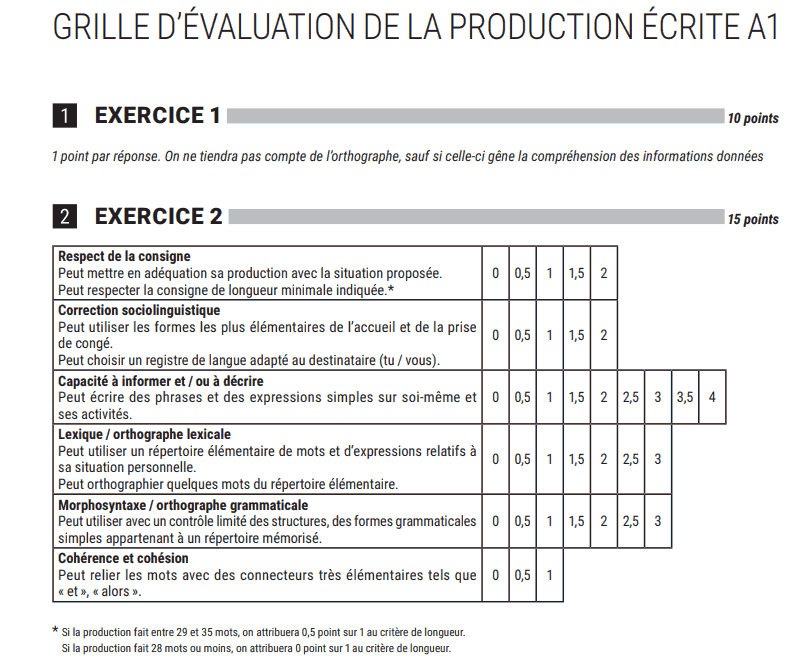
Look at how the 15 points of Exercise 2 are shared out:
| Criterion | Points | What it means for you |
|---|---|---|
| Respect de la consigne | 2 | Answer the situation and write the minimum number of words |
| Correction sociolinguistique | 2 | Greeting and sign-off (Salut… À bientôt !), the right tu or vous |
| Capacité à informer / décrire | 4 | Simple sentences about yourself and your activities |
| Lexique / orthographe lexicale | 3 | Basic vocabulary, a few words spelled correctly |
| Morphosyntaxe / orthographe grammaticale | 3 | Correct verbs, articles and adjectives |
| Cohérence et cohésion | 1 | Simple connectors: et, alors |
Only 4 points out of 15 are for what you say. The other 11 are for how you say it. And the word count matters: between 29 and 35 words you get only 0.5 out of 1 for length, and with 28 words or fewer you get 0.
What DELF A1 examiners look for
- Verbs conjugated correctly, in the present tense only
- Grammar: articles (un, une, le, la) and adjective agreement
- Basic connectors: et, mais, alors
- The overall flow of the text: does it read like a real message?
DELF A2: tell, explain and react
At A2, you must know the passé composé and the imparfait. The examiner can now ask « Pourquoi ? » and expects you to elaborate: J'aime ma maison parce qu'elle est près de mon école et que j'ai ma propre chambre.
DELF A2 Production Écrite: 2 exercises
- Exercise 1 (13 points): tell an event or an experience, for example a festival, holidays, a shopping trip, school or university.
- Exercise 2 (12 points): a letter or email: an invitation, and accepting or refusing one.
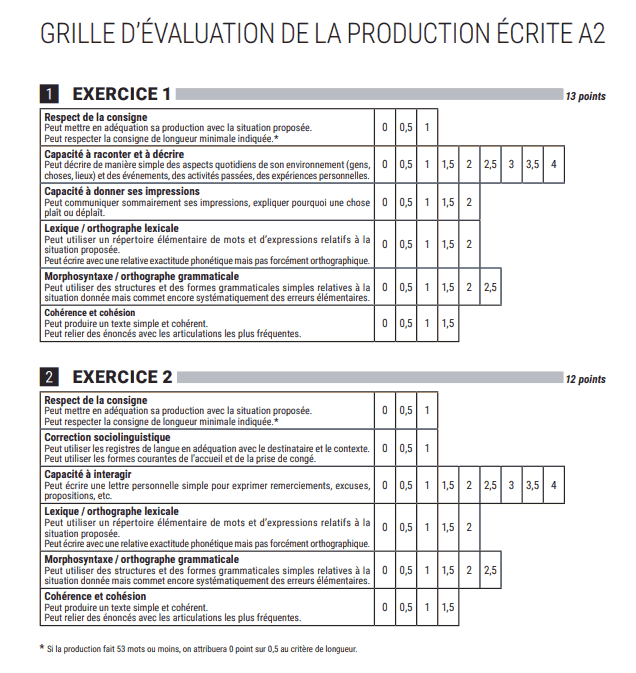
| Exercise 1 (13 pts) | Points | Exercise 2 (12 pts) | Points |
|---|---|---|---|
| Respect de la consigne | 1 | Respect de la consigne | 1 |
| Capacité à raconter et à décrire | 4 | Correction sociolinguistique | 1 |
| Capacité à donner ses impressions | 2 | Capacité à interagir | 4 |
| Lexique / orthographe lexicale | 2 | Lexique / orthographe lexicale | 2 |
| Morphosyntaxe / orthographe grammaticale | 2.5 | Morphosyntaxe / orthographe grammaticale | 2.5 |
| Cohérence et cohésion | 1.5 | Cohérence et cohésion | 1.5 |
Notice the 2 points for « donner ses impressions » in Exercise 1: a story without feelings (c'était génial, j'étais content(e), j'ai adoré) loses them, even if every sentence is correct. And a text of 53 words or fewer gets 0 for length. Our guide to DELF A2 Production Écrite has a model answer.
DELF A2 Production Orale: 3 parts
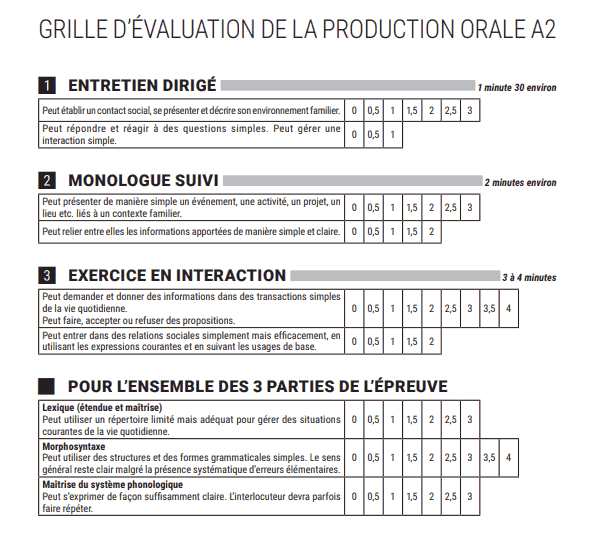
| Part | Time | Points |
|---|---|---|
| Entretien dirigé: introduce yourself, answer simple questions | about 1 min 30 | 4 |
| Monologue suivi: present an event, activity, project or place | about 2 min | 5 |
| Exercice en interaction: a role-play in an everyday situation | 3 to 4 min | 6 |
| For the whole test: vocabulary (3), grammar (4), pronunciation (3) | 10 |
10 of the 25 points are given for your language across the whole test: vocabulary, grammar and pronunciation. Short, one-word answers leave the examiner nothing to mark.
Why students get fewer marks than they expect
When students say « the exam went well », they usually mean they understood the task and said what they wanted to say. But the marking grids show that content is only a small part of the score:
- In DELF A1 writing (Exercise 2), only 4 of 15 points are for the information you give.
- A message with no greeting or sign-off loses points in correction sociolinguistique.
- A text that is too short loses the length point, or half of it.
- A text written as one block, with no paragraphs, loses points in cohérence et cohésion.
- Each criterion is marked in half points, so small mistakes in verbs and articles add up quickly.
This is why a student can feel confident after the exam and still score much lower than expected. The good news: once you know the grid, every one of these points can be won back.
A1 or A1+, A2 or A2+
Examiners don't only check whether you reached the level: they also see how well you reached it. A strong A1 candidate is often judged A1+: their French already shows signs of A2. In the same way, an A2 candidate with a better capacity, already moving towards B1, is judged A2+. Aiming for the « + » is the safest way to pass comfortably.
When are you ready for DELF A2?
You are ready for A2 when you can explain things well, in writing and in speaking, using varied connectors: d'abord, ensuite, parce que, mais, alors, enfin.
Quick check:
- Can I tell what I did last weekend, using the passé composé?
- Can I describe how it was, using the imparfait (il faisait beau, c'était super)?
- Can I answer « Pourquoi ? » with parce que?
- Can I write 60–80 words to invite someone, or to accept or refuse an invitation?
If you said yes to all four, prepare A2. If not, start with A1 and build a solid base in the present tense.
Common mistakes in DELF A1 and A2
- No paragraphs: the text is one big block. Write one paragraph per idea.
- No salutation: always start with Salut / Bonjour / Cher… and end with À bientôt / Bises / Cordialement and your name.
- Only the present tense at A2: a story needs the passé composé and the imparfait.
- Silence in the speaking test: use simple « filler » expressions to gain time and sound natural: Je pense que…, Bien sûr !, Alors…
Prepare DELF A1 or A2 with us
Our DELF A1 course has 15 themes and our DELF A2 course has 18 themes. Each is a guided session of about 2 hours, with listening, reading, writing and speaking in the official DELF format, plus a full mock exam. Theme 1 of each level is free.
More DELF guides: DELF A1 exam format · DELF A2 Production Écrite · DELF exam dates and fees in India
Frequently asked questions
What is the difference between DELF A1 and A2?
At A1 you communicate in very familiar situations with simple sentences in the present tense. At A2 you tell past events with the passé composé and the imparfait, explain your reasons with « parce que » and interact in everyday situations. The A2 written exam is also longer: about 1 h 40 instead of 1 h 20.
What are the passing marks for DELF A1 and A2?
You need at least 50 out of 100 overall, and at least 5 out of 25 in each of the four sections: listening, reading, writing and speaking.
How is the DELF A1 writing marked?
Exercise 1 (a form) is marked out of 10, with 1 point per answer. Exercise 2 (a short message) is marked out of 15 with six criteria: following the task, greeting and register, giving information, vocabulary, grammar and connectors.
Why did I get a low score when the exam went well?
Because the marking grid gives most points for how you write and speak, not only for what you say: word count, greeting and sign-off, paragraphs, verb forms and connectors all have their own points.
Can I take DELF A2 without passing A1?
Yes. Each DELF level is a separate diploma, so you can register directly for the level that matches your French.